Peter Bryce and The White Plague

According to the World Health Organization, World Tuberculosis Day is marked every March 24, on the day in 1882 when Dr. Robert Koch announced that he had found the cause of tuberculosis, the TB Bacillus.  According to the WHO site, at the time “TB was raging through Europe and the Americas, causing the death of one out of seven people.”

Once I saw that statistic, I understood more clearly why Peter H. Bryce had decided to pursue public health over neurology.  He had studied in Paris with some of the pioneers of neurology, but then he came home to Canada and went into the civil service in order to work on public health issues, including TB.  Public health held none of the prestige (not to mention compensation) of neurology and I had always wondered why he chose it.

But when I think of one in seven people, I think of a class of 27 students I teach at the moment.  In that class, about four people would die of tuberculosis if this were the late 19th century.  In 1882, the same year Koch identified the bacillus, Bryce joined the civil service in Ontario and started working on the first public health code in Canada – a document designed to reduce such death tolls.

When Peter Bryce reported on the appalling health conditions in the Indian Residential School system in 1907, most of the deaths were caused by TB.  By then, in most of Canada the death rate due to tuberculosis had been reduced dramatically. But in the IRS system nearly one-quarter of all children would die or were dying of TB.  When the story broke in the Ottawa Citizen on November 15, 1907, the headline was Schools Aid White Plague – white plague being a popular description of tuberculosis at the time.

Tuberculosis impacted Peter Bryce throughout his life.  A note in my family tree says that Peter’s sister Katherine died of TB in 1876 at the age of 17.  Further, Bryce’s son Henderson died of TB on December 31, 1931 at the age of 42.  Henderson was the only one of Peter Bryce’s six children who went into medicine.  After graduating from the University of Toronto with his medical degree, Henderson went to Haida Gwaii and worked as a doctor in Port Clemons and later at Stave Falls in the Lower Mainland where a huge hydroelectric dam was being built. Later, he did a residency in surgery at the University of Chicago and became the head of surgery at Vancouver General Hospital before discovering he had TB.
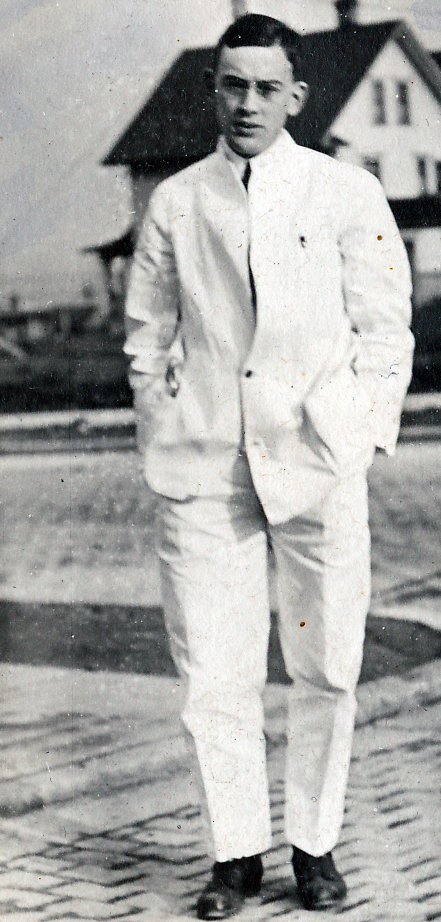
henderson_lynde_3

Dr. Henderson Bryce, ca. 1914

This is where the story gets personal for me, because Henderson was my grandfather and this is my family’s story. Granddad found out that he had TB sometime after my Aunt Helen was born in 1916.  At the time, wisdom was that he would have a better chance of surviving if he moved to a drier part of the world, and so Henderson took a locum assignment in Princeton B.C., where my father was born, before settling in Kelowna in 1920.  It seems Henderson was in remission for much of this time, because he worked at Kelowna General Hospital for a few years, but by the late 1920s, the TB had re-emerged, and he was dying.
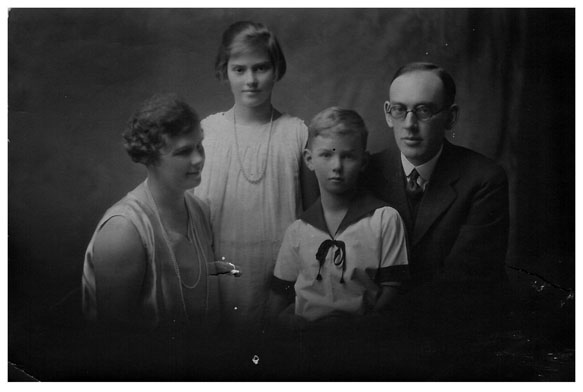
grandfather and family 1927 upload

Grandmother Jessie, Aunt Helen, my father Bill and Grandfather Henderson Bryce, 1927

A few years ago my Aunt Helen (who was 15 in 1931) told me she remembered taking the ferry up Okanagan Lake to meet her Uncle Bill, who had been sent by Peter Bryce (my Aunt called him “the old man”) to be with his brother, and to take the body back to Ottawa for burial.  Shortly after my grandfather died on New Year’s Eve 1931, Uncle Bill transported his body back to Ottawa by train, arriving in time to hold a funeral service on January 9th.

A few days later Peter Bryce came home and told his family he was leaving to take a trip to the West Indies the next day.  On January 12, he got on the Empress of Australia at New York City, and two days later on January 14, 1932, Peter H. Bryce died in his cabin, alone.

It is a tragedy that a man who did so much for so many, died alone at sea with the knowledge that the very disease he had spent his life fighting, had killed his son.  But for me the real tragedy is that my father lost his father at the age of 13, and moreover watched his father die so slowly and painfully.  The ravages of TB have the power to reach across generations, as so many in the Indigenous community know all too well.

A 15-year-old Canadian girl died of tuberculosis in January this year. Her name was Ileen Kooneeliusie and she was from the hamlet of Qikiqtarjuag in Nunavut. Andre Picard in the Globe and Mail writes about her death and the high prevalence of TB in the territory (in the interests of giving credit where it is due, the story was first told by Nick Murray of the CBC).  In Canada, 4.7 people out of every 100,000 die of tuberculosis.  In Nunavut, the rate is 229.6 per 100,000.  It’s a disease that can be stopped, but early detection is a key, and Picard notes that this child’s death was caused by cultural and language differences

The mother of Ileen Kooneeliusie said that the principal barrier to getting care for her daughter was an inability to communicate the severity of her condition – because none of the nurses at the clinic spoke Inuktitut.  She was not taken seriously.  The language gap, and the condescension of health workers from away, have consistently been identified as an impediment to care in Nunavut and other Indigenous communities.

Peter Bryce would not be surprised.
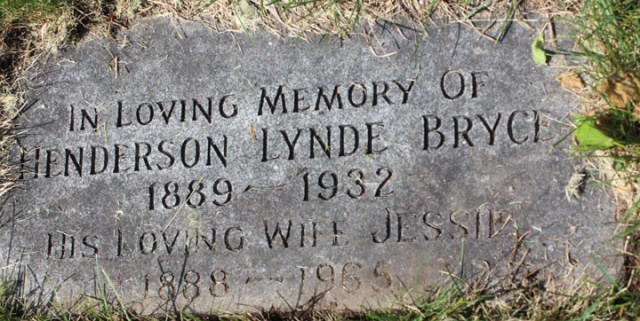
henderson_lynde

At the Bryce family plot in Beechwood cemetery

The documentary film Finding Peter Bryce is currently in post-production but it needs funding to be completed.  If you are interested in contributing, you can give through our partners, the Canadian Public Health Association and receive a tax receipt in return.  Go to How to donate to the Film to find out more. Click here to see the promotional trailer.   If you have other questions, suggestions or thoughts, please contact me at andyj.bryce@gmail.com
 

The Stories of Those Who Worked in Residential Schools

Far be it for me to comment on the speech defending the residential school system, given by Ontario Senator Lynn Beyak this week.  People with far greater authority and much more knowledge than I have already done that. But there is something that Beyak said that sparked my interest, and that was her acknowledgement of the people who actually worked in the schools with those children. “I speak partly for the record, but mostly in memory of the kindly and well-intentioned men and women and their descendants — perhaps some of us here in this chamber — whose remarkable works, good deeds and historical tales in the residential schools go unacknowledged for the most part,” she said.

This is an opportunity to consider those who worked on the frontlines. For one moment, let’s set aside the obvioiusly mentally ill and evil people who lurked there and assume that there were good, competent people who served in that system.  I wonder what kind of trauma they suffered from working in some of those schools? Certainly, it won’t compare with the trauma suffered by the children, but I am sure that many people were scarred by what they saw and experienced.

John Milloy, in his book A National Crime, outlines what happened to some of them, and how their complaints and concerns were handled by Duncan Campbell Scott.  It is important to remember the big picture here – this was an underfunded system, and these schools were often caught in a bureaucratic dance between the federal government and the churches.  Milloy says the impact of these two factors can be seen at the level of the teachers, principals and administrators who ran those schools.

For many staff the schools were not peaceful, rewarding places to work; they were not havens of civilization. Rather they were sites of struggle against poverty, the result of underfunding, and, of course, against cultural difference and, therefore against the children themselves. Locked away in an establishment often distant from non-Aboriginal settlements, always impenetrable to the gaze of almost everyone in Canada, they carried on this struggle against the children and their culture within an atmosphere of considerable stress, fatigue, and anxiety.  The conditions may well have dulled the staffs’ sensitivity to the children’s hunger, ill-kept look and illness, and often perhaps inevitably, pushed the application of discipline over the line into physical abuse and transformed what was to be a culture of care into one of violence.

Milloy’s best example of a competent man thrown into a dysfunctional system is the Reverend Lett, who along with his wife and baby arrived at St. George’s school in 1923.  The building was falling apart, the farm and orchards were neglected and the children were starving.  The family lived in the main school building, primarily in one bedroom.  The living and dining rooms were public and shared with the other members of the staff, with whom they also shared a bath and toilet.  On one side of their living quarters was the students’ dining room; on the floor above were the dormitories, and below were the play rooms.  They got little to no peace or privacy, and the time and effort required to run the school brought Mrs. Lett to the point of breakdown.  Reverend Lett wrote to Duncan Campbell Scott about the situation to no avail and it would be another four years before the Department of Indian Affairs would do anything about his calls for a new and better facility.

Milloy also recounts how Scott dealt with other letters of complaint from staff and school administrators and even other departmental officials.  W. H. Graham, an inspector in the western provinces wrote to Scott about the poor conditions at Round Lake over a number of years.  Finally Scott answered him and denounced his most detailed report because it was based on complaints from a teacher named Miss Affleck.  In Scott’s mind, Affleck was a malcontent to be ignored because she had reported on the incompetence of her principal (who fired her upon learning of the complaint).  We are lucky to have at least this one account – most of the complaints submitted by staff at the schools were not even put on file.

The residential school system never paid well enough to attract trained teachers, so the people who worked in those schools often had no experience or qualification. Some came from the churches, where residential school work was considered “mission” service.  For many poor people who couldn’t afford to go to college, working in a residential school was the only way to become a teacher. I can just imagine the shock of being a young person, just away from home, going to work in a remote residential school where the children were uncared-for and unloved, where there was no pretense of teaching them anything, and where the strap was the only method of control.  I can also imagine their horror in those schools where the abuse was sexual as well as physical.

So perhaps Senator Beyak is right – perhaps it’s time to hear the stories of those who worked at those schools.  Let’s hear from the descendants of people like Reverend Lett, W.H. Graham, and Miss Affleck, and the many others who went to work in those schools.  Tell the family stories, and bear witness to this part of our history.   But be prepared – the evidence indicates those stories will not likely recount the remarkable works and good deeds imagined by the Senator.

The documentary film Finding Peter Bryce is currently in post-production but it needs funding to be completed.  If you are interested in contributing, you can give through our partners, the Canadian Public Health Association and receive a tax receipt in return.  Go to How to donate to the Film to find out more. Click here to see the promotional trailer.   If you have other questions, suggestions or thoughts, please contact me at andyj.bryce@gmail.com
The Connection between Peter Bryce and Alexander Graham Bell

It was one of those stories that my Mother would tell us when the talk around the kitchen table got to family matters. “You know the Bryces knew Alexander Graham Bell,” she would say. Usually when Mom said that we would turn to our Dad who was ambivalent about his Bryce relatives and ask him, and he would say something noncommittal.

“They were all Scottish and they lived in the same place or something,” he would say before changing the topic.

It was such a fantastic assertion, that I never really talked about it as a kid. Later on I did some research into the rumour and came up empty. I had assumed the Bryces knew the Bells in Scotland. But the Bells were from Edinburgh, while the Bryces came from the village of Doune – north and west of Edinburgh. It was unlikely they knew each other in Scotland.  Also, the Bryces emigrated in 1843 and the Bells in 1870, disproving the idea that perhaps our ancestors emigrated with the Bells.

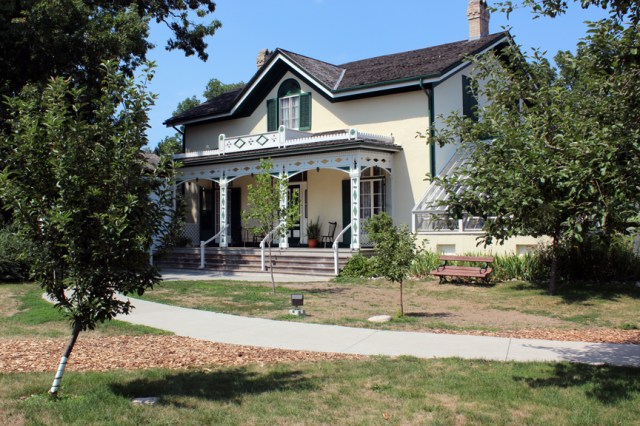
The Bell family moved to the new world after Alexander Graham’s brother Edward had died of tuberculosis.  Alexander Graham himself was considered “sickly” and his father wanted him to live in a place with better air – both Edinburgh and London had pollution problems due to the heavy use of coal for heating and power.  So in 1870, the Bell family bought a farmhouse and ten acres at Tutela Heights in the south end of Brantford.

bell-homstead-12

The Bell Homestead at Tutela Heights

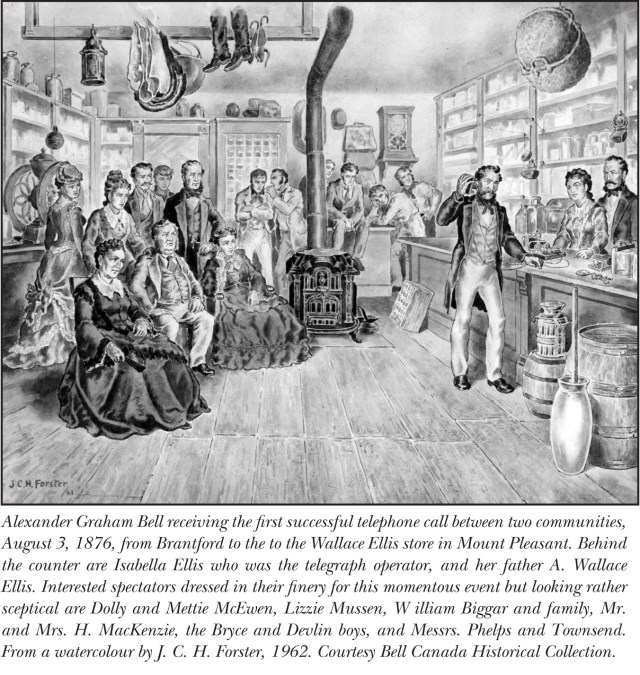
I had known from grade school that the Bells had lived in Brantford, but I didn’t make the connection that maybe the Bells and the Bryces really did know each other until I read The Work of Their Hands, a history of the village written by Dr. Sharon Jaeger. It turns out that Bell had carried out a key experiment using the Ellis General Store in Mount Pleasant.  He had strung wires between Tutela Heights and Mount Pleasant – a distance of about four miles.  He used the store as his receiving post, since it had a telegraph office and the needed infrastructure.  Bell had instructed his uncle David, who was back at the Bell homestead, to quote Shakespeare into the machine at an appointed time.  Jaeger quotes Bell’s recollection from a speech he gave 30 years later.

Bell later recalled during a 1906 speech for the Brantford Board of Trade that he sat in Mr. Ellis’ store and waited “with the receiver and my watch in my hand.” Suddenly he heard a preliminary cough, and then the words, “to be or not to be.” “Gentlemen,” exclaimed Dr. Bell, “it was to be…and for the first time between Brantford and Mount Pleasant.”

A week later Bell made the first long distance call between Brantford and Paris, Ontario and that call went down in history, while the experiment in Mount Pleasant was forgotten. But what really caught my attention was an illustration in The Work of Their Hands.

heritage book-FINAL

It turns out that not only did the Bryces know the Bells, but they witnessed this important episode of history.  I have yet to find any reference to this event in Peter Bryce’s writing, but one has to wonder how much impact this event would have had on him.  Peter Bryce was 23 years old at the time and going to school at the University of Toronto.

“It was the forefront of just about everything to do with our modern society,” says Brantford historian Bill Darfler.  “It was the beginning of scientific exploration for just about anything you can imagine. The medical world went through a revolution at that time.  Our political system changed – our country confederated in 1867.”

This event signifies what we often forget about Peter Bryce.  It’s easy to look at his portrait with the stiff white collar and walrus moustache and think of him as old-fashioned.  But nothing could be further from the truth – he was on the cutting edge of medicine and science at a time when change was in the air.   Bell’s telephone would transform society, but so would Bryce’s vision for good public health.  And for one brief evening the two  came together at the Ellis General Store in Mount Pleasant, Ontario.

The documentary film Finding Peter Bryce is currently in post-production but it needs funding to be completed.  If you are interested in contributing, you can give through our partners, the Canadian Public Health Association and receive a tax receipt in return.  Go to How to donate to the Film to find out more. Click here to see the promotional trailer.   If you have other questions, suggestions or thoughts, please contact me at andyj.bryce@gmail.com