Rooting Around Archives Pays Dividends

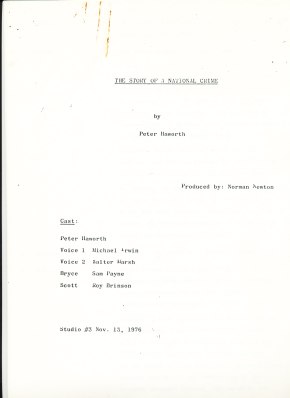
radio script cover

It took me about ten months to read the script for a CBC radio show about Peter Bryce produced in 1976 called The Story of a National Crime. As I mentioned in last week’s post, a producer named Peter Haworth had stumbled across Peter H. Bryce’s story while working on another program about Duncan Campbell Scott. One of the curious aspects of Haworth’s story is his account of trying to find information about Peter H Bryce and discovering a file that had been cleaned out of vital information.

I had been given the script by my second cousin, Mary Robinson Ramsay. Her father Jock Robinson had gathered material about Peter H Bryce and Mary had found the file while clearing out his belongings just a couple of years ago. She gave me the file at a family reunion in August 2014 and I had quickly gone through the contents, and then put it away while I tended to more pressing issues. When I finally got around to reading the script, I was surprised by Haworth’s story and as I outlined last week, was inspired to look at the file myself

Meanwhile I began a search for a copy of the radio show. After talking to Deborah Wilson at CBC Victoria, I tracked down the CBC archivist who as it turned out, was away on paternity leave. I sent him an email and a couple of months later, he returned to work and took a look for it. From the script I had vital information: the name of the show, its production date, and the names of the producers – Peter Haworth and Norman Newton. I was sure CBC would have it but the archivist got back to me a few days later with disappointing news – there was no copy of the show at CBC.

Let’s fast forward to this morning when I was rooting around the B.C. Archive. Early on in my genealogical research I had searched the Archive for information about my grandfather who had worked in B.C. about one hundred years ago. I found more references to Peter Bryce (his father) instead, and that was when I realized there was much more to Peter’s story. I have gone off in a number of directions since then, but until this morning had not returned to the B.C. Archive. This time I struck gold – I found a record of a sound recording of “The Story of a National Crime.” How ironic that this valuable resource sits in the B.C. Archive, just a ten minute drive from my home.

archive liting

It turns out that producer Norman Newton who lived and died in B.C., had donated his files to the Archive, and among them is the above recording.   The B.C. Archive record clears up a couple of details which may have hampered the CBC Archivist. The airdate on B.C. Archive record is December 23, 1976. I had assumed the production date of November 13, 1976 which was on the script, would be the airdate. More importantly, I discovered that the documentary was produced for a series called Audience, which was produced at CBC Vancouver.

In terms of our documentary Finding Peter Bryce, this will give us a valuable element to the story. As well, the Archive also has a copy of the radio show on Duncan Campbell Scott, another valuable resource. But more importantly there is a collection of Norman Newton’s material. Both Newton and Haworth are dead; Newton died three years ago and Haworth passed away just last year. That collection may have information on the production of “The Story of a National Crime,” and may fill out another part of the Peter Bryce story. The journey to find Peter Bryce continues with more archival research.

Movie Trailer:  https://youtu.be/2QAAX8yN90E
Facebook:  https://www.facebook.com/PeterHBryce/


The Missing Files of Peter H Bryce

NACThe story as laid out by Producer Peter Haworth, is startling  Haworth was working on a documentary about my great-grandfather Peter Bryce for the CBC radio show Ideas in 1976. He had read about Peter Bryce while doing research on Duncan Campbell Scott, the Canadian poet who ran the Department of Indian Affairs for over 40 years. Haworth read Bryce’s 1922 pamphlet The Story of a National Crime and had successfully pitched a story to Ideas. That’s when he started to ask questions.

I began my search at the Department of Indian Affairs. “Yes” an official said, he had heard of Bryce. They had a file on him. Yes, the controversy had been documented. He seemed to remember that there were questions raised in the Commons about it. Would I phone back when he’d had a chance to look into it? I did so, but within that period of three hours his manner had changed. He was apparently “wrong” about the Commons debate. There was no record of it..No, they had nothing on Bryce, and anyway all the material from that period had been sent on to the National Archives.

At the Archives, I looked at Bryce’s file. It was empty except for an obituary: Peter Henderson Bryce (1853-1928). “It’s been stripped,” the archivist said. “That happens sometimes.” There was nothing in Hansard, either or anywhere else for that matter, about Bryce. Even the Archives catalogue, which seems to contain everything, did not list his pamphlet. Bryce might just was well have never existed.

When I read this last winter, I was familiar with some of my great-grandfather’s file because information from it was used in Dr. Adam Green’s thesis Humanitarian MD, but I had missed the opportunity to vet the file when I was doing research at the archive the year before. So, when my fellow producer Peter Campbell and I decided to do principal shooting in Ottawa in August, I put the archive on my To Do list, and filed a request to view Dr. Bryce’s personnel file.

Despite a couple of stumbles with Library and Archives Canada (I could write an entire column on that experience, but in the end they were helpful and accommodating) Peter and I managed to take a look at the file, and to my surprise, I found nothing to do with Bryce’s time at the Department of Indian Affairs. He had been relieved of his duties at DIA in 1913, but this file only extended back to 1919, the period from 1904 until 1918 was entirely missing. Here’s my reaction as captured by Peter Campbell:

This fall I filed an Access to Information request and a couple of weeks later I received a notice that said there was nothing confidential in the file and that I had indeed seen the entire Peter Henderson Bryce file. Is it coincidence that these files are missing? Well, my bet is the file was cleaned out sometime in the distant past – perhaps 1932, when Peter Bryce died, or maybe in 1976 when Peter Haworth started asking questions. We will probably never know, but there are more questions to ask.  We are waiting to hear back from the Archive on the process of how personnel files get moved from government departments to the archive, and then we will try to determine if the file was cleaned out before or after it was stored.

Either way, this episode shows how at some point, whether it be in Peter Bryce’s lifetime, in Duncan Campbell Scott’s tenure at Indian Affairs, or some later time, someone saw fit to erase his role in the DIA from the records of government.


How a High School Student Challenged the Historical Record

I love this story for three reasons.  First it shows the power of the Internet – there is just so much information out there that if you can find a way to leverage it, you can contradict a famous authority on a subject.  Second, I love the poise this young woman showed in responding to the criticisms of her work. And finally it reminds me that history is often incomplete, if not totally incorrect and that goes right to the heart of why I decided to do a documentary on my great-grandfather.

When I began my research I realized there wasn’t even a public building named after my great-grandfather Dr. Peter H. Bryce, and the only public recognition I could find for him was the Peter H. Bryce Award, established by the First Nations Caring Society. One of the most satisfying aspects of working on Finding Peter Bryce has been watching the recognition grow.  The School of Public Health at U of T has established the Waakebiness Bryce School of Public Health, and very soon Beechwood Cemetery. which is Canada’s National Cemetery, will be unveiling an historical plaque in Peter Bryce’s honour. I’ll be there with a film crew to witness the event and it will become part of Finding Peter Bryce

But I digress – back to the article.  It’s a great read about contradicting the narratives of the past – enjoy!

http://www.thedailybeast.com/articles/2015/08/01/the-teen-who-exposed-a-professor-s-myth.html

Finding a Story to Tell

As most of you know my regular job is “teacher.” I don’t know when it happened, but sometime between 1998 and say 2007 or so, I stopped being a television guy and became a teacher. I didn’t really think I would go back to video production or journalism – I did small projects on and off, but they all seemed ho-hum. The voice of Milton Fruchtman, a mentor from the Banff Centre came back to haunt me.

“Don’t make a film unless you have something to say.” he used to say. It turned out I was saying enough in the classroom and I didn’t need to say anything else.

Until 2011, that is – that’s when I inherited a box full of my mother’s genealogical research. One of Mom’s retirement projects was to research her family, including my father’s side of the family. Growing up I knew my mother’s relatives quite well – we spent our summers with them. But my father’s family was a mystery – every once and a while over the dinner table, Mom and Dad would tell stories about eccentric Bryce relatives, but beyond having Christmas and Thanksgiving with my Aunt Helen’s family, the Bryces never figured in our lives.

In 2011, I started finding references to my great-grandfather, Dr. Peter H. Bryce. Dad had always talked about how he had written the first health code in Canada, and how the guy was eccentric. His proof was a house in Rockcliffe Park in Ottawa, and a crazy will that would never be allowed today.   What I found was that my great-grandfather had documented high mortality rates due to infectious disease in the Indian Residential School system in 1907. As a result of his findings and his insistence on advocating for improved health conditions for Indigenous people he was shuffled out of Indian Affairs, and he retired a bitter man in 1921. After writing a tell-all pamphlet about his experiences in Indian Affairs in 1922, my great-grandfather faded from the scene, to be forgotten by history. As I reached out and read more about Peter Bryce, I found a small group of people who had written about him and worked to keep his name alive. Then I found that his work was being cited by the Truth and Reconciliation Commission – after being in the shadows for more than century, Dr. Peter H. Bryce was back in the news. The difference was, this time someone was listening.

I decided to produce a documentary on Peter Bryce last summer when I met my second cousin Mary Ramsay – also a descendant for Peter Bryce’s. She had been a councilor in Walkerton in the late 90s and had read the health inspector’s reports about the town’s troublesome water system. “I told them, we have to deal with this” she told me at a Bryce reunion. “But they kept saying ‘no-no – if we are in trouble the inspectors will tell us.’ They wouldn’t listen.”

All of a sudden I knew I had a story to tell.