Peter Bryce and the Politics of Fear and Hatred

I seem to relate everything to Peter Bryce these days, and in the aftermath of Donald Trump’s win this week I found myself linking Peter Bryce to the news of the day through the lens of immigration.  As has been well-outlined in the last few months, Trump’s position on immigration is exclusionary and based on the politics of fear and hate.  On his website, Trump proposes building a wall between Mexico and the U-S, vetting immigrants to see if they share American values, and restricting immigration from places where terrorism is active.  It seems Trump and his supporters only want immigrants who fit a narrow profile.   This is not the first time that race and immigration have been tied together – they have also been issues in Canada.

Well before Peter Bryce joined the federal government, Canada first faced the issue of race and immigration.  In the country’s early years, the government’s plan was to populate the prairies with the poor of Great Britain.   This proved to be a disaster because poor immigrants from the slums of Britain’s big cities had no idea how to farm, much less survive the brutal weather extremes of the prairies.  In 1896 Clifford Sifton, Minister of the Interior in the Laurier government, promoted the idea of bringing in immigrants from places like Scandinavia, Germany and the steppes of eastern Europe.  Despite protests from Canadians who wanted the country to be populated only by the British, this radical idea worked, and more than two million immigrants would pour into the country in the next few years.

clifford_sifton_2

Sir Clifford Sifton

Peter Bryce was a supporter of immigration, and that may surprise many who see him strictly as the man who lobbied for better health conditions among Indigenous people.  He was a believer in the colonial approach to economics and he saw Canada as an empty land full of economic potential; all it needed was a willing workforce to make it happen.  Bryce also believed that Canada’s future lay in being an agrarian superpower, with numerous small communities servicing a vast agricultural factory which would help feed the world.

As the chief bureaucrat for the board of health in Ontario, he worked to improve health conditions for immigrants who were flooding into the slums of Toronto, and actively fought racism caused by the belief that immigrant populations brought disease to the city.  Later in the federal government, he was the chief medical officer for two departments:  Indian Affairs, and Immigration.   His biggest impact in the Immigration department was the construction of hygienic and efficient immigration depots, and screening for communicable diseases.

But his support of immigration went deeper than that.  In 1928, long after he had retired, Bryce published a collection of papers called The Value to Canada of the Continental Immigrant.  The impetus for this collection was the narrative of the day that immigrants were to be feared because of their differences.  By this time Bryce was in his mid 70s, but he had spent six months travelling Canada to visit many of the communities which arose from the immigration first promoted by Sir Clifford Sifton, who he also interviewed.
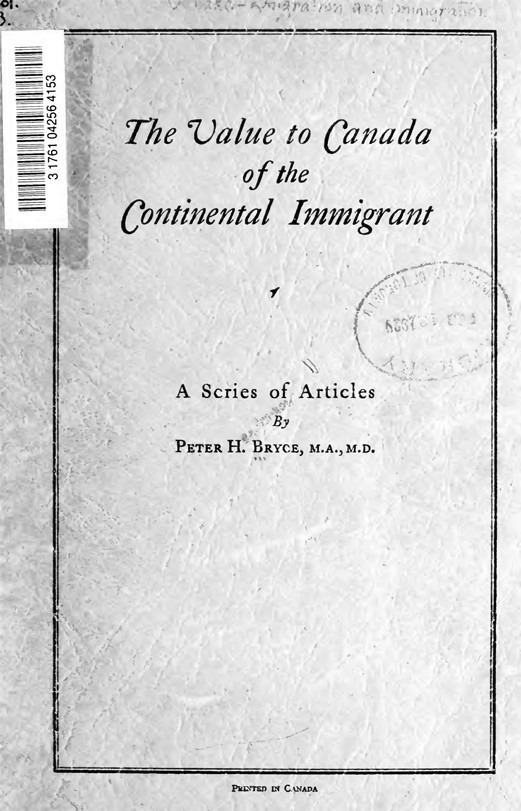
The value to Canada of the continental immigrant: a series of ar

Among the places he visited were Castlegar B.C., where he spent a day with Doukhbours who had been persecuted in Russia because of their radical views.  He also travelled to the Selkirk region of Manitoba, and central Saskatchewan and Alberta where communities of Scandinavians, Germans, and Ukrainians had been established.  Bryce’s theme was consistent; these people shared Canadian values, and they were working hard to bring wealth to their communities and to the country in general.

Today among my friends and family are the descendants of those immigrants. My brother’s wife is from the German community in Fort Saskatchewan; my wife’s sister is married to a descendant of the Scandinavian community; a friend and colleague is a descendant of the Doukhbour community.  The fact that we mix so easily and yet celebrate our ethnic backgrounds contradicts the racist politics which characterized Donald Trump’s campaign, and reminds me that strong voices like Peter Bryce’s are needed today, more than ever.
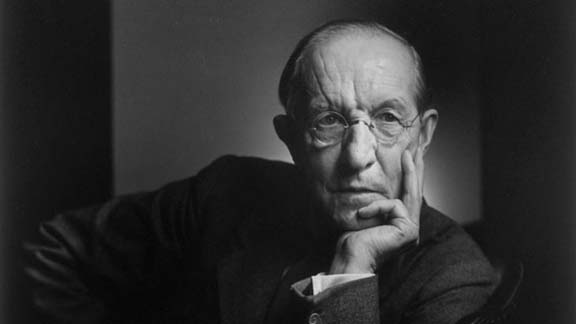
The ghost of Duncan Campbell Scott haunts the halls of INAC

I couldn’t help thinking of Duncan Campbell Scott when I read Doug Cuthand’s article this weekend.  Cuthand is a member of the Little Pine First Nation and a columnist for both the Saskatoon Star-Phoenix and Regina Leader-Post.  Before making his living as filmmaker and writer, Doug Cuthand spent fifteen years with the Federation of Saskatchewan Indian Nations.  He is well-qualified to write about Indigenous issues.

In a column published November 5 called Replace hidebound INAC with a 21st century ministry, Cuthand takes a critical look at Indigenous and Northern Affairs Canada and calls on the government to replace it with something more modern, and less redolent of the colonial era of Canada’s development.

“It also has a long history of meddling in First Nations affairs and providing substandard services,” says Cuthand. “The department has been a law unto itself for generations.”

Well, definitely since 1913 when the department came under the control of Canada’s mandarin/poet Duncan Campbell Scott.  This was a man who joined the department in 1879 (when family friend Sir John A. MacDonald recommended him) and left in 1932 – a 53 year career in one department.  No one person left a greater stamp on Indian Affairs than Duncan Campbell Scott.

duncan-campbell-scott-library-archives-canada

Duncan Campbell Scott

It was Scott who advocated for the assimilation of Indigenous people, and increased residential school attendance from 11 thousand in 1913 to 17 thousand students in 1932.  He did this by forcing students to go to residential schools, all the while knowing of the health problems at those schools, and failing to get enough money to adequately pay for their care, feeding and education.  Scott was the most parsimonious of bureaucrats, ultimately valuing dollars over lives.   This could well have been due to his belief that Indigenous people would disappear because of their perceived “inferior qualities.”  In 1920 he explained in parliament

I want to get rid of the Indian problem. I do not think as a matter of fact, that the country ought to continuously protect a class of people who are able to stand alone… Our objective is to continue until there is not a single Indian in Canada that has not been absorbed into the body politic and there is no Indian question, and no Indian Department…

Of course there was one voice that said these people could stand on their own, given half a chance.  That voice belonged to my great-grandfather, Dr. Peter Henderson Bryce and he had the evidence to back up his statement.  One of the first things Bryce did when he was hired in Indian Affairs in 1904 was study the evidence to see if the myth that Indigenous people were spiritually, emotionally and physically inferior was true.  Bryce’s minister, Sir Clifford Sifton had said just that in a committee meeting in 1900, so it was a career-limiting moment when Bryce reported that there was no indication of physical inferiority in Indigenous people.  What he did find instead was that European people who lived in the same conditions as Indigenous people had similar rates of disease and mortality. This was not news that the penny-pinching Duncan Campbell Scott would have welcomed, so instead Scott did his best to discredit my great-grandfather.

“It was Duncan Campbell Scott who received Peter Bryce’s report (on conditions in residential schools) and moved to suppress that report and discredit your great-grandfather,” says Cindy Blackstock.  When Duncan Campbell Scott became deputy superintendent of Indian Affairs in 1913, he relieved Peter H. Bryce from his duties as Chief Medical Officer, and discontinued the practice of issuing an annual report on the health of Indigenous people.

The First Nations case against the Federal government at the Canadian Human Rights Tribunal proved that the federal government spends less on social services for Indigenous children than on non-Indigenous children.  I also note that INAC lapsed (meaning “didn’t spend”) 900 million dollars last year.  These two facts alone make me think Mr. Cuthand has a good point – it seems not much has changed since the colonial days of Duncan Campbell Scott and Peter H. Bryce.


Long Threads Running Deep

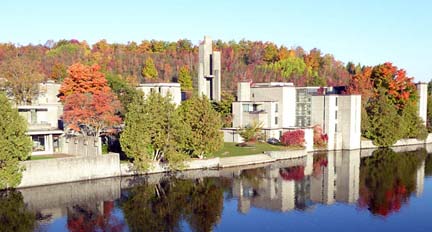
champlain_fall_1024

There have been moments in the last few years when the threads of my past have come together in the journey to find Peter Bryce, and each time it has happened, I have reflected on how this story has been all around me, for so long.  One source of many of these threads has been Trent University where I graduated with a B.A. in November 1979.

The first thread connected to Trent is that one of the historians I found in my early work on Peter Bryce was a woman named Dr. Nancy Christie, who had done significant research on the Social Gospel movement.  Peter Bryce was a member of the Social Gospel which  recognized the problems inherent in the industrialized society of the 19th century and proposed proactive solutions.  He was an important Social Gospel figure because of his role in public health – a proactive way for government to improve the health of all.   I knew Nancy Christie as an undergrad at Trent – it was a very small place at the time with a student population not much larger than an urban high school.

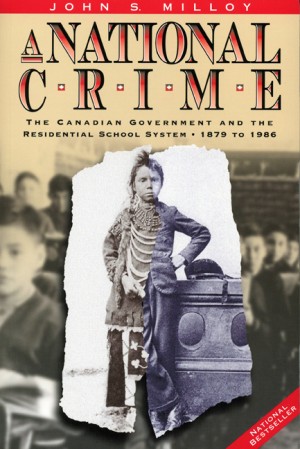
As it turned out Nancy’s research was on a totally different aspect of the Social Gospel but the second connection to Trent was very strong.  One of the most important books on residential schools was Dr. John Milloy’s  A National Crime.  Even though it was published almost twenty years ago, Milloy’s book stands as an excellent overview of the Indian Residential School system.  We had the pleasure of interviewing John in his Ballieboro home last spring for the documentary Finding Peter Bryce – he had just retired from his career as a professor of history at Trent.

national-crime

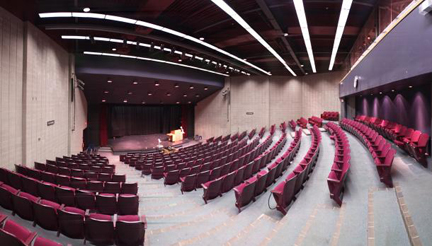
But it is the third connection with Trent which perhaps touches me the most – and that is Wenjack Theatre.  I can recall many hours of lectures at Wenjack Theatre – it was a main lecture hall and pretty much everyone who went to Trent in my time has taken lectures there.  Of course, most of the rest of us are now familiar with the Wenjack name because Gord Downie has just released The Secret Path – a CD, graphic novel and animated film about the story of Chanie Wenjack, who froze to death trying to escape Cecilia Jeffrey Residential School in Kenora.  His home was almost a thousand kilometers away and he tried to walk home with no food or shelter and wearing only a windbreaker.  Downie’s work is a deeply sad insight into the despair which many of these children felt.

According to the Trent University website, when Otonabee College was being built in 1973 a group of students from what is now the Indigenous Studies department successfully lobbied to have the theatre named after Chanie (who was called Charlie in the official records) Wenjack.  According to a release from the university in September 2016, “The students saw this dedication as an opportunity for Trent to strengthen its Indigenous Studies program, and establish itself as a force for change, hope, and a positive educational experience.”

wenjack-theatre

Wenjack Theatre

I learned about the Chanie Wenjack story when a friend of mine told me about it in 1978.  At the time the story had no resonance for me.  It wasn’t until a few years ago when I started hearing testimony from the TRC and researching my great-grandfather that the importance of that name became clear. When I heard about Downie’s project I thought back 38 years.  These threads have been with me for a long time and seem to run a long way.

Big News to start the New Year

I have some great news to start off 2016 – we (Peter Campbell of Gumboot Productions and I) are finalizing a collaboration with the National Centre for Truth and Reconciliation (NCTR) to produce a 20 minute educational film about Peter Bryce.   Of course, I am thrilled about this; the primary reason I embarked on this journey to find Peter Bryce is to give my ancestor the recognition he deserves. Putting this kind of material in front of school children goes a long way to meeting that goal.

We plan to have this production ready by the end of March, and that means we have a busy few months ahead of us. We are still working on the full documentary and we need to complete one more principal shoot in the spring. I will be spending much of this winter organizing that shoot, and finding funds to complete the longer film as well as writing and producing the educational film.

This educational film caps off a tremendous year for us. In March, we attended and filmed the naming ceremony for the Waakebiness-Bryce Indigenous Health Institute at the University of Toronto. We followed that up with a week-long shoot in Ottawa where we filmed the unveiling of an historical plaque honouring Peter Bryce at Beechwood Cemetery, visited Peter Bryce’s home in Rockcliffe and interviewed a wide variety of people, including Ellie Kerr – a grand-daughter of Peter Bryce who is perhaps the only person alive who remembers him.

Finally, I would be remiss if I didn’t tell you about Charlene Bearhead, one of the key figures in this initiative. We first met her at the unveiling ceremony at Beechwood. Charlene is the Education Lead at the NCTR and it is her job to collaborate with Ministries of Education, school authorities, and Universities. She also supports the work of educators across the country to ensure that the critical truth about the history of Indian Residential Schools and reconciliation education are being delivered in classrooms.. Charlene told us how excited she was about the documentary, and followed up that conversation with a meeting in the fall – and that’s when the educational film really began to take shape. Her advocacy and appreciation of the story of Peter Bryce has given us extra momentum going into 2016, which promises to be an important year in the journey to find Peter Bryce.


The Missing Files of Peter H Bryce

NACThe story as laid out by Producer Peter Haworth, is startling  Haworth was working on a documentary about my great-grandfather Peter Bryce for the CBC radio show Ideas in 1976. He had read about Peter Bryce while doing research on Duncan Campbell Scott, the Canadian poet who ran the Department of Indian Affairs for over 40 years. Haworth read Bryce’s 1922 pamphlet The Story of a National Crime and had successfully pitched a story to Ideas. That’s when he started to ask questions.

I began my search at the Department of Indian Affairs. “Yes” an official said, he had heard of Bryce. They had a file on him. Yes, the controversy had been documented. He seemed to remember that there were questions raised in the Commons about it. Would I phone back when he’d had a chance to look into it? I did so, but within that period of three hours his manner had changed. He was apparently “wrong” about the Commons debate. There was no record of it..No, they had nothing on Bryce, and anyway all the material from that period had been sent on to the National Archives.

At the Archives, I looked at Bryce’s file. It was empty except for an obituary: Peter Henderson Bryce (1853-1928). “It’s been stripped,” the archivist said. “That happens sometimes.” There was nothing in Hansard, either or anywhere else for that matter, about Bryce. Even the Archives catalogue, which seems to contain everything, did not list his pamphlet. Bryce might just was well have never existed.

When I read this last winter, I was familiar with some of my great-grandfather’s file because information from it was used in Dr. Adam Green’s thesis Humanitarian MD, but I had missed the opportunity to vet the file when I was doing research at the archive the year before. So, when my fellow producer Peter Campbell and I decided to do principal shooting in Ottawa in August, I put the archive on my To Do list, and filed a request to view Dr. Bryce’s personnel file.

Despite a couple of stumbles with Library and Archives Canada (I could write an entire column on that experience, but in the end they were helpful and accommodating) Peter and I managed to take a look at the file, and to my surprise, I found nothing to do with Bryce’s time at the Department of Indian Affairs. He had been relieved of his duties at DIA in 1913, but this file only extended back to 1919, the period from 1904 until 1918 was entirely missing. Here’s my reaction as captured by Peter Campbell:

This fall I filed an Access to Information request and a couple of weeks later I received a notice that said there was nothing confidential in the file and that I had indeed seen the entire Peter Henderson Bryce file. Is it coincidence that these files are missing? Well, my bet is the file was cleaned out sometime in the distant past – perhaps 1932, when Peter Bryce died, or maybe in 1976 when Peter Haworth started asking questions. We will probably never know, but there are more questions to ask.  We are waiting to hear back from the Archive on the process of how personnel files get moved from government departments to the archive, and then we will try to determine if the file was cleaned out before or after it was stored.

Either way, this episode shows how at some point, whether it be in Peter Bryce’s lifetime, in Duncan Campbell Scott’s tenure at Indian Affairs, or some later time, someone saw fit to erase his role in the DIA from the records of government.


How a High School Student Challenged the Historical Record

I love this story for three reasons.  First it shows the power of the Internet – there is just so much information out there that if you can find a way to leverage it, you can contradict a famous authority on a subject.  Second, I love the poise this young woman showed in responding to the criticisms of her work. And finally it reminds me that history is often incomplete, if not totally incorrect and that goes right to the heart of why I decided to do a documentary on my great-grandfather.

When I began my research I realized there wasn’t even a public building named after my great-grandfather Dr. Peter H. Bryce, and the only public recognition I could find for him was the Peter H. Bryce Award, established by the First Nations Caring Society. One of the most satisfying aspects of working on Finding Peter Bryce has been watching the recognition grow.  The School of Public Health at U of T has established the Waakebiness Bryce School of Public Health, and very soon Beechwood Cemetery. which is Canada’s National Cemetery, will be unveiling an historical plaque in Peter Bryce’s honour. I’ll be there with a film crew to witness the event and it will become part of Finding Peter Bryce

But I digress – back to the article.  It’s a great read about contradicting the narratives of the past – enjoy!

http://www.thedailybeast.com/articles/2015/08/01/the-teen-who-exposed-a-professor-s-myth.html